

Answers to what we hear most often — about working with us, and about electrical and solar systems in general. If your question isn't covered here, reach out and we'll answer it directly.
Yes — Roots Power holds California contractor's license CSLB #901433 and is fully licensed and bonded. We're happy to provide license verification on request.
We serve all of Humboldt County, based out of Eureka, CA. If your property is just outside the county, reach out anyway — we can often still help.
Generally, yes — with one caveat worth knowing. An estimate is usually based on a site visit or even just a phone conversation, not a full investigation — we're typically not crawling through your attic or underneath the house at that stage. That quicker, surface-level look is exactly why estimates are free, and it's also where the variability between an estimate and the final cost comes from. A bid usually requires that kind of hands-on digging, which is part of why bids take longer and cost something to prepare.
An estimate is a non-binding snapshot of the job based on what's visible or known at the time — it's a starting point, not a locked-in number, and it's expected to shift if new information comes up once work begins. A quote or bid, on the other hand, is a binding, contractual total for the entire scope of work, and it only changes through a formal change order: we identify what's different, present the added cost, and nothing moves forward until you approve it in writing. Estimates are also much quicker to put together — sometimes on the spot, on site or over the phone — and usually cover just labor and materials. A bid takes more time to prepare, since it also has to account for overhead, profit, and a margin for the unexpected. That's part of why a bid almost always comes in higher than an estimate for the same job: a binding number means the contractor has to price in the risk of being wrong, and an estimate doesn't carry that same risk.
A mechanics lien is a legal claim a contractor can record against a property when work has been completed and payment hasn't followed. Because it attaches to the property itself, not just to the person who hired us, it can cloud the title and make the property difficult to sell, refinance, or transfer until it's resolved — which is what gives it real teeth as a collection tool. California law requires specific notices and timelines to be followed before a lien can even be filed, and we follow every one of them. We treat a mechanics lien as a last resort, used only after every reasonable, direct attempt to resolve payment has failed. Recording a lien doesn't collect the money on its own — if the debt still goes unpaid, the next and final step is enforcing it through the courts via a foreclosure action, which can ultimately compel a sale of the property to cover what's owed. That's exactly the outcome filing the lien is meant to help everyone avoid — it's a serious action with real consequences, and not one we take lightly.
We're not a round-the-clock emergency service. If you're dealing with an active safety issue, contact your utility or emergency services first. For everything else, give us a call and we'll get you scheduled as soon as we're able.
Both. Some customers just need design and permitting help; others come to us with their own engineered plans already drawn up and just need a crew to install them. See the Design & Build section of our Services page for more on how that works.
We select the highest-quality parts, components, and equipment available for every job — not just whatever's cheapest or easiest to get. Here are some of the brands available to us:
















Also available through our supply chain: B-Line, Cooper Wiring Devices, Cutler-Hammer, Pass & Seymour, and Thomas & Betts — each now fully absorbed into their parent brand's current lineup (Eaton or Legrand), which is why they're not shown here as separate logos.
Almost certainly. We regularly take on work that doesn't fit a standard category — if you're not sure, just reach out and describe what you need.
It works on two levels. Solar is the root of nearly all power on Earth — even fossil fuels are ancient stored sunlight — so between our solar work and our everyday electrical work, the name covers both halves of the business. It's also a nod to RJ's own path through the Rastafari community, where "roots power" speaks to the strength found in simple, natural, sometimes ancient ways of living. It felt like the right name from the start, and it's only grown into itself since.
The easiest way is to find your utility meter — that's the point where the utility company's power actually connects to your property, and your main panel (also called the service panel) is typically mounted right next to it, sometimes even in the same enclosure. If you have overhead service, look up: you'll see a line running from a nearby utility pole down to a point on your house, usually near the roofline, called the service drop — follow it down and it leads straight to the meter and panel. If you have underground service, there's no line to spot from the street; power comes up from below ground instead, usually through a conduit that runs straight into the meter. Either way, the meter and panel are almost always mounted on an exterior wall, often on the side of the house closest to the street or the nearest utility pole.
The main panel (also called the service panel) is where power enters your home from the utility and gets distributed to individual circuits. A subpanel is a secondary panel fed from the main panel, often added to serve a detached structure, an addition, or an area that needs more circuits than the main panel has room for.
A few common signs your main panel needs an upgrade: breakers that trip frequently, a panel that still uses fuses instead of breakers, significant rust or corrosion on the outer enclosure, signs of water or moisture getting inside it, a home over 40 years old that hasn't been updated, or you're adding something big — a hot tub, an EV charger, a large addition — that the existing panel wasn't sized for. If in doubt, it's worth having a licensed electrician take a look.
A licensed electrician has passed state-required training and testing, carries the insurance and bonding required to legally pull permits, and is accountable to code inspections. Unlicensed electrical work can create real safety hazards, void your homeowner's insurance, and cause problems later when you sell the house.
Wiring materials and methods that were standard decades ago — knob-and-tube wiring, aluminum branch wiring, ungrounded outlets — don't meet today's safety codes and weren't designed for the amount of power a modern household uses. Rewiring an older home isn't just about compliance, it materially reduces fire risk.
Most electrical work beyond simple like-for-like repairs requires a permit and inspection. Permits exist to make sure the work is actually safe, not just to slow you down — an electrician willing to skip permitting on a job that requires one is a red flag, not a shortcut.
A GFCI (Ground-Fault Circuit Interrupter) outlet shuts power off almost instantly if it detects current leaking somewhere it shouldn't — like through water, or through a person. Code requires them in kitchens, bathrooms, garages, outdoors, and other damp or grounded locations.
Before assuming something's wrong, check for a tripped GFCI. Those are the areas code requires GFCI protection in, and a single GFCI outlet often protects several other outlets downstream of it — so one trip can knock out power in more than one spot at once, sometimes in a different room than the outlet itself. Look for an outlet with "Test" and "Reset" buttons on it and press "Reset." If that brings the power back, you're all set. If it trips again right away, that's worth having looked at rather than resetting it repeatedly.
The vast majority of flickering lights come down to a loose connection somewhere in the system. If the flickering is systemic — happening throughout the whole house, not just one fixture or room — the first step is actually calling your utility, not us: have them check their connections at the pole and at the meter to rule out a problem on their end. If that checks out and the flickering continues, that's when it's time to call an electrician. Worth knowing going in: tracking down a loose connection isn't usually a quick fix. It often takes real investigation — opening outlet and switch boxes, pulling devices, and checking connections one by one until the culprit turns up.
Flickering or dimming lights, warm or discolored outlet covers, a persistent burning smell, breakers that trip repeatedly, or outlets that buzz or spark. Any of these are worth having looked at rather than waiting.
Solar panels convert sunlight directly into DC electricity through the photovoltaic effect — sunlight striking the semiconductor material inside each cell knocks electrons loose, and that movement of electrons is what generates electric current. An inverter then converts that DC power into the AC power your home actually runs on. Depending on your system, extra power either feeds back into the grid, charges a battery, or both.
A grid-tied system stays connected to the utility grid and sends excess power back to it. An off-grid system stands entirely on its own, usually paired with battery storage, with no utility connection at all. A hybrid system does both — connected to the grid, but with battery backup for outages.
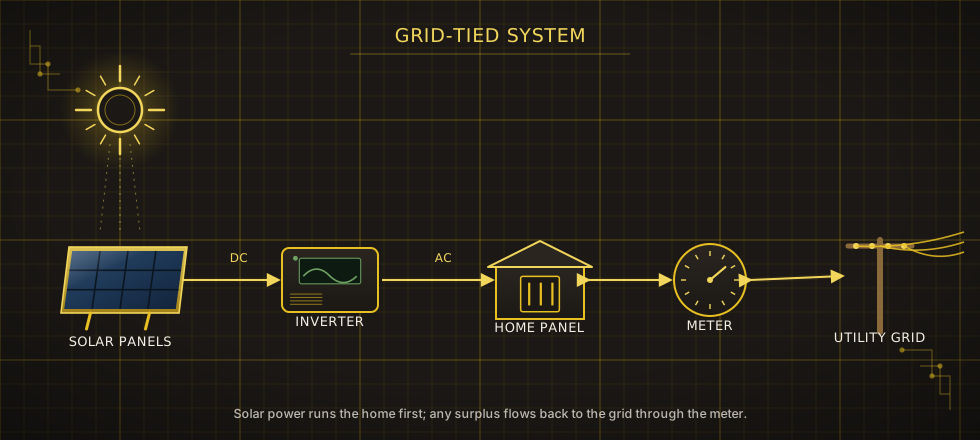
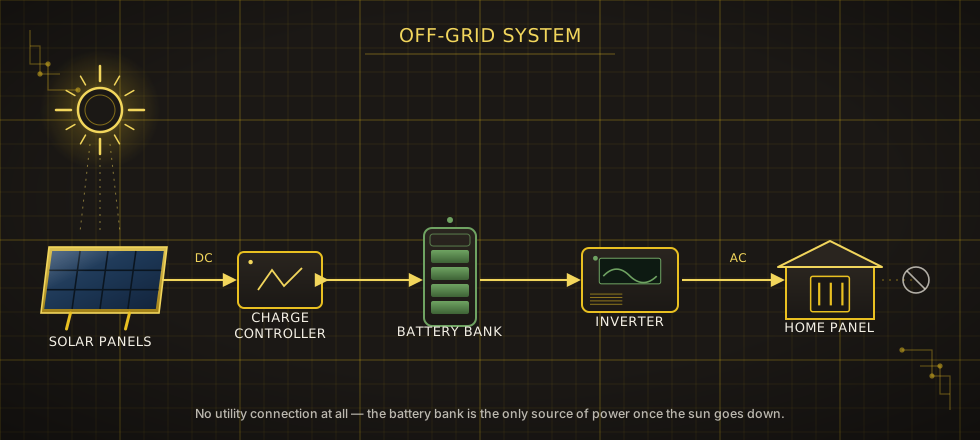
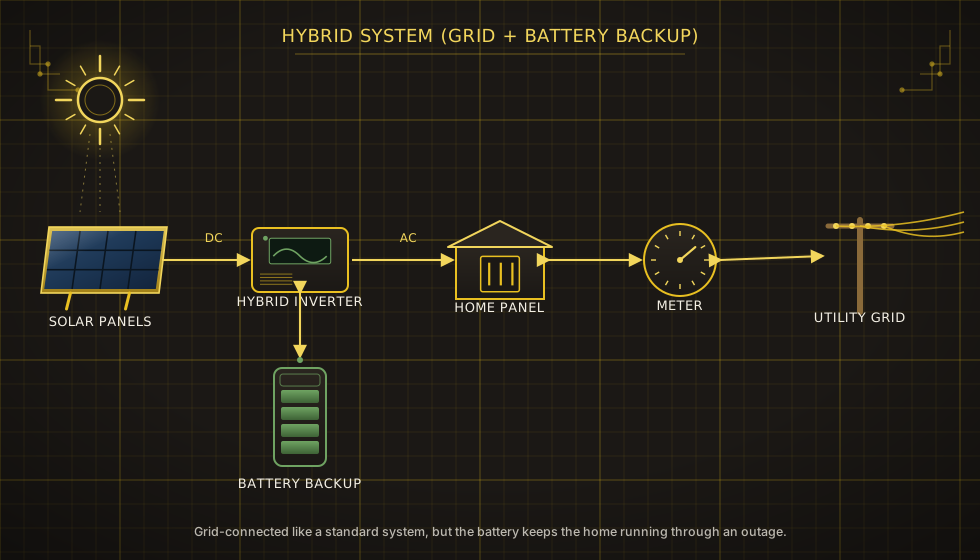
Not necessarily. A grid-tied system without batteries works fine and is usually less expensive, but it won't keep your lights on during a power outage — when the grid goes down, a standard grid-tied system shuts off too, for utility worker safety. If backup power during outages matters to you, battery storage is what makes that possible.
Only if your system includes battery storage, or is designed as an off-grid system. A standard grid-tied solar system without batteries is required to shut off during a grid outage, even if the sun is shining.
Net metering is the general idea: excess solar power your system sends back to the grid earns you a bill credit, offsetting what you draw from the grid at other times, like at night. The details vary a lot by utility, and they've changed recently. For PG&E customers specifically, the traditional Net Energy Metering (NEM) program closed to new solar applications on April 15, 2023, replaced by the Net Billing Tariff (NBT) — branded by PG&E as the Solar Billing Plan, and also commonly called NEM 3.0. Instead of crediting exported power at the full retail rate like the old program did, the Solar Billing Plan credits it based on its "avoided cost" — roughly what that power is worth to the grid at the specific hour it's exported — which averages out to about 75% less than the old rate. That's a big part of why battery storage has become so much more valuable for new solar customers: using your own stored power to avoid buying at retail rates is worth more than selling that same power back to the grid for a much smaller credit. Systems that interconnected before April 15, 2023 keep their original NEM terms for 20 years from that date.
It depends on your energy usage and the type of system — a roof-mount array needs enough usable, unshaded roof area, while a ground-mount system needs open land instead. As a rough planning number, modern monocrystalline panels produce somewhere around 19–23 watts per square foot, so 20 watts per square foot is a reasonable ballpark. That works out to roughly 150 square feet of panels for a 3kW system (typical for an 800–1,200 sq ft home), 250 square feet for a 5kW system (1,200–2,000 sq ft home), and 350+ square feet for a 7kW-or-larger system (2,000+ sq ft home). These are starting points, not a substitute for an actual site visit — every property's usage, roof orientation, and shading is different, which is why we always assess in person before sizing a system.
Most panels are warrantied for 25+ years and keep producing well beyond that, just at gradually reduced output. Maintenance is minimal — occasional cleaning and keeping an eye on surrounding vegetation for shading are usually all that's needed. For a real photovoltaic case study: Europe's oldest grid-connected solar power plant, a 10kW system called TISO-10, has been feeding power into the Swiss grid from a university rooftop near Lugano since 1982 — over 40 years and counting. Researchers who've tracked it closely found that after 35 years, most of the original modules still delivered at least 80% of their original output, despite some visible wear like cracking and corrosion. There's a neat connection to its longevity, too: TISO's cells were built using silicon technology adapted directly from satellites, tying the solar panel on your roof back to the same lineage as the earliest solar-powered spacecraft.
Battery backup stores energy your solar system already generated, so it's silent, requires no fuel, and kicks in instantly. A standby generator burns fuel — propane or natural gas, typically — to generate power during an outage and needs periodic maintenance. Many systems use both together for maximum reliability.
Battery technology for solar storage has gone through several distinct eras. The starting point was the same lead-acid starting battery used to start a car engine — built for a short burst of high current, but poorly suited to solar use, since repeatedly draining it deeply damages the internal plates and shortens its life dramatically. That led to deep cycle lead-acid batteries, built with thicker plates specifically to handle hundreds or thousands of full discharge-and-recharge cycles, which became the long-standing industry standard for off-grid and backup power — first as flooded batteries needing regular maintenance, later as sealed, maintenance-free AGM and gel versions. Along the way, other chemistries filled niche roles as alternatives to lead-acid: nickel-cadmium held up better in extreme temperatures, and nickel-iron batteries — commonly called "Edison batteries" after Thomas Edison, who patented an improved version in 1901 — became known for extraordinary durability, tolerating complete discharge and overcharging without damage, with some units still running after 50-plus years. Both were heavier and less efficient than lead-acid for the same storage capacity, which kept them niche. Today, lithium-ion has taken over as the standard for new systems, and two cathode chemistries hold the vast majority of that market: NMC (nickel manganese cobalt oxide), the chemistry behind most electric vehicles and consumer electronics, and LiFePO4 (lithium iron phosphate), which has become the dominant choice specifically for stationary solar storage.
LiFePO4 (lithium iron phosphate) is the clear favorite for home solar storage today, for two separate reasons — it beats lead-acid decisively, and it also beats the other major lithium chemistry for this particular job. Lead-acid's disadvantage is straightforward: it can typically only be discharged to about 50% before damage sets in, degrades if it isn't recharged fully on a regular basis, and lasts a few hundred charge cycles at most. Those are awkward limits for a technology that's supposed to ride out cloudy stretches and irregular charging, and lithium simply doesn't share them — it discharges to 80–100% and lasts for thousands of cycles instead of hundreds. Between the two dominant lithium chemistries, though, LiFePO4 wins out over NMC specifically for stationary use: NMC packs more energy into a smaller, lighter cell, which matters a lot in an electric vehicle, but it's also more prone to thermal runaway if it's damaged or overheated. LiFePO4's chemistry is inherently more stable — it doesn't release oxygen when it overheats, which essentially eliminates that risk — and it holds up for two to three times as many charge cycles. For something that's going to sit in or next to your house for the next 15–20 years, that safety and longevity margin matters more than shaving off some size and weight.
Humboldt and Mendocino counties aren't just where we happen to do business — they're genuinely part of where the modern solar industry got its start. In the late 1960s and through the 1970s, thousands of young people left cities up and down the West Coast looking for a simpler, self-sufficient life, and Northern California became the epicenter of that movement: the migration ran north through Marin, then Sonoma, and settled heavily in Mendocino and Humboldt, where a developer was selling logged-off 40-acre parcels for a few hundred dollars an acre, often on handshake terms. Living that far off the grid meant no utility line was coming, so if you wanted lights on at night or music playing, you had to figure out how to make your own power — and a lot of these back-to-the-landers turned out to be serious tinkerers.
Humboldt's own David Katz is a direct product of that moment: he moved to Redway in 1979, built an off-grid home, and started selling solar panels to his neighbors out of his garage under the name Alternative Energy Engineering. AEE grew into a national solar distributor before Katz sold it in 2005; part of that company eventually became part of what's now SunRun, one of the largest solar companies in the country. Down in Mendocino, John Schaeffer was doing the same thing from the other direction — he'd moved to a commune in 1971, and by 1978 had co-founded what became Real Goods in Willits, one of the very first companies in the country to sell solar panels at retail. There's a well-documented story from that era of a solar sales rep flying up from Los Angeles in a suit, driving a Porsche full of panels, utterly confused about who in rural Northern California was placing such large cash orders — only to find barefoot, off-grid homesteaders paying in cash, largely funded by the region's marijuana economy at the time.
This wasn't confined to solar, either. The same do-it-yourself spirit ran through the wider off-grid renewable energy scene of that era — people like Bob-O Schultze, a longtime fixture of Home Power magazine (the movement's central publication), and micro-hydro pioneers like Don Harris, inventor of the widely used Harris Hydroelectric turbine. Harris didn't live or invent his turbine in Humboldt County, but he frequently traveled to the Pacific Northwest and California's rugged North Coast — including the Yurok Reservation — to help bring small-scale hydropower to exactly the kind of remote, off-grid properties this region was full of. None of this was corporate R&D — it was a community of self-taught tinkerers, swapping knowledge and building an industry because they genuinely needed the power to live the life they'd chosen.
The institutional side of this story runs just as deep, and it's arguably even more directly tied to Humboldt County specifically. In 1989, two Humboldt State engineering professors, Peter Lehman and Charles Chamberlin, connected by phone with Louis Schatz, a Tacoma businessman who'd made his fortune manufacturing aerospace materials — his company's work ended up in NASA's space shuttle and Navy submarines — and had a personal passion for hydrogen energy. That conversation turned into funding for what became the Schatz Energy Research Center, still based at Cal Poly Humboldt today. Their first project captured the era's improvisational spirit: hydrogen fuel cells weren't something you could simply order from a catalog in 1989, so the team built their own from scratch to power a small research station at the Trinidad marine lab, which ran successfully for over two decades. That hands-on expertise paid off less than ten years later — in 1998, the Schatz Center built and unveiled what's recognized as America's first street-ready fuel-cell car, after a fleet of hydrogen-powered golf carts they'd engineered had already been in daily use for a year and a half. That same lab is still leading hydrogen and fuel-cell research on the North Coast today. Between the grassroots tinkerers and the university researchers, that home-grown ingenuity is a real part of why solar and renewable energy expertise runs so deep in Humboldt County.